Outsourcing and Other Interesting Words
- 18 April 2014
- Serhiy Lavrynenko
- Management
- 8036

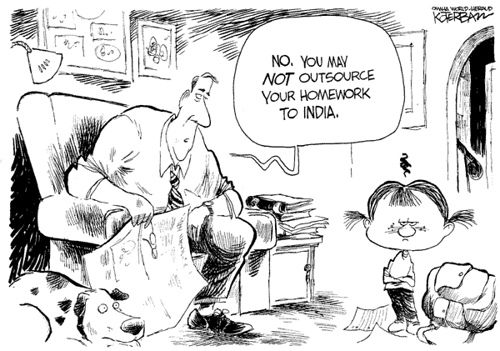
Here's an interesting thing: today a lot of specialists work in outsourcing in Ukraine, but few of them can clearly explain what it is. Even more people have only heard about outsourcing but take it as an obscure foreign word.
So, outsourcing is a long-term delegation of a part of business processes from one company to another. Basically, that's it. Each word in this definition is appropriate and important. If the cooperation is not going to last long, then it is not outsourcing but only a one-time service. If cooperation does not imply any delegation of a part of business processes, then it is only a project. And of course, outsourcing cannot be performed within one company. For better understanding, I'll provide you with a few example.
Example 1. Company A orders a corporate website at company B. It is not outsourcing because the time-frames of the service and volume of work are limited.
Example 2. Company A hires Company B to move their business online; it requires website design, its development, and support. In this case, we are dealing with outsourcing because the services involve operational and support business processes on a long-term basis. Since I've promised a short explanation, I think this will be enough. As a bonus, I'll explain to you two more interesting words.
Offshoring is a type of outsourcing when a company is relocated to another country. As a rule, it is due to differences in tax legislations and cost of labor in other countries.
Nearshoring is a kind of offshoring which implies locating an outsourcing company in a nearby country. It is caused by the client's desire to minimize the impact of time differences, language and cultural peculiarities on the work process.
The chances are that you've got the point. Just in case, there are two more examples.
Example 3. Company A is located in the U.S. and is a software vendor. They make a deal with company B which is in Ukraine. Company B has a team of programmers who work within a simplified tax system, and their salaries are significantly lower in comparison with their American counterparts. It is called offshore outsourcing.
Example 4. Company A from Russia exports its products all over post-Soviet countries, cuts a deal with company B from Ukraine, which operates as an international call-center. Ukrainian staff, unlike their Russian colleagues, speak at least three languages and have a similar mindset and of course lower salaries (usually this is a pretty important factor). Such thing is called nearshore outsourcing.
Now, it looks like the end. If you come up with any questions, please leave them in comments.


